Two answers diverge from ten seconds
Two AI agents change the same code in opposite directions. This is a fictional example. A search request currently waits up to ten seconds. A cuts that to three; B raises it to thirty. A wants to avoid a long wait. B wants to give slow responses a chance. Both reasons make sense, but they cannot both set the timeout for the same request.
Before discarding either attempt, you want to preserve both the change and its reasoning. A Git repository holds code and its change history. The interesting question is how independently each attempt needs to be treated, rather than how many agents are working.
Separate the changes and their access
Cloudflare Artifacts is a service for creating and managing Git repositories for agent tasks. Its architecture guide describes independent forks, each with its own history, remote, Git tokens and lifecycle.
Its authentication guide scopes Git tokens to repositories. Separation does not automatically narrow Cloudflare API or Workers binding privileges.
Applied to our invented example, the design would give A and B separate repositories from the reviewed ten-second baseline, with each task allowed to write only to its own. Keeping B under review need not require keeping A’s write access open. Files and network access available to the executing program need separate restrictions. A Git access boundary should not be read as a guarantee of execution sandboxing.
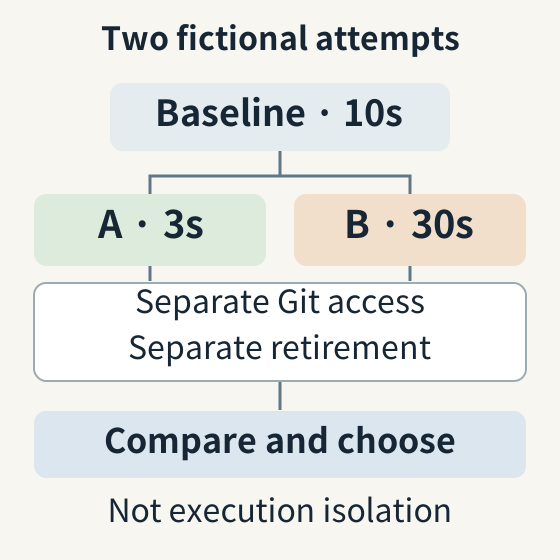
Someone still chooses three or thirty
The reviewer can now compare the baseline with both changes. Imagine testing a response that arrives after two seconds, another after eight, and a request that never returns. Is this a screen where abandoning the eight-second response is acceptable? Does the feature give users a reason to wait? The smaller number alone cannot make A the better choice.
Before merging, V would decide when this particular screen should stop waiting. Bring the chosen change and its rationale into the baseline; the decision might even require revising both proposals. Separate histories preserve the alternatives for comparison. They do not determine which behavior belongs in the product.
V’s rule: do they end at different times?
Before creating a repository per task, I would ask when access to this attempt should end and how long its result should remain. Suppose A finishes review today while B must remain available for comparison next week. Different end conditions give separation a concrete purpose. Record the adoption decision, the reason for retaining the attempt and who will retire it.
Now consider the strongest countercase: the same team keeps access to the same code and retains every attempt for the same period. I would start with branches in one repository. If no access or retention boundary needs to end separately, adding repositories creates more names and cleanup decisions to manage. This is an operational judgment, not a measured saving in cost or time.
The retention documentation says repositories persist until explicitly deleted. Rejecting an attempt or expiring its token does not delete it.
What this explanation establishes
Checked October 6, 2026: Artifacts is in open beta on the Workers Paid plan. Limits: 1GB/repository, 32MB/file or blob, 1TB/account; account increases can be requested. Beta announcement · Pricing · Limits
This explanation uses public documentation, without a hands-on deployment or performance test. Check current pricing and limits before adopting it.
An NDA review nearly became program execution follows the boundary between reading a repository and executing a program. It continues the execution question kept separate here.