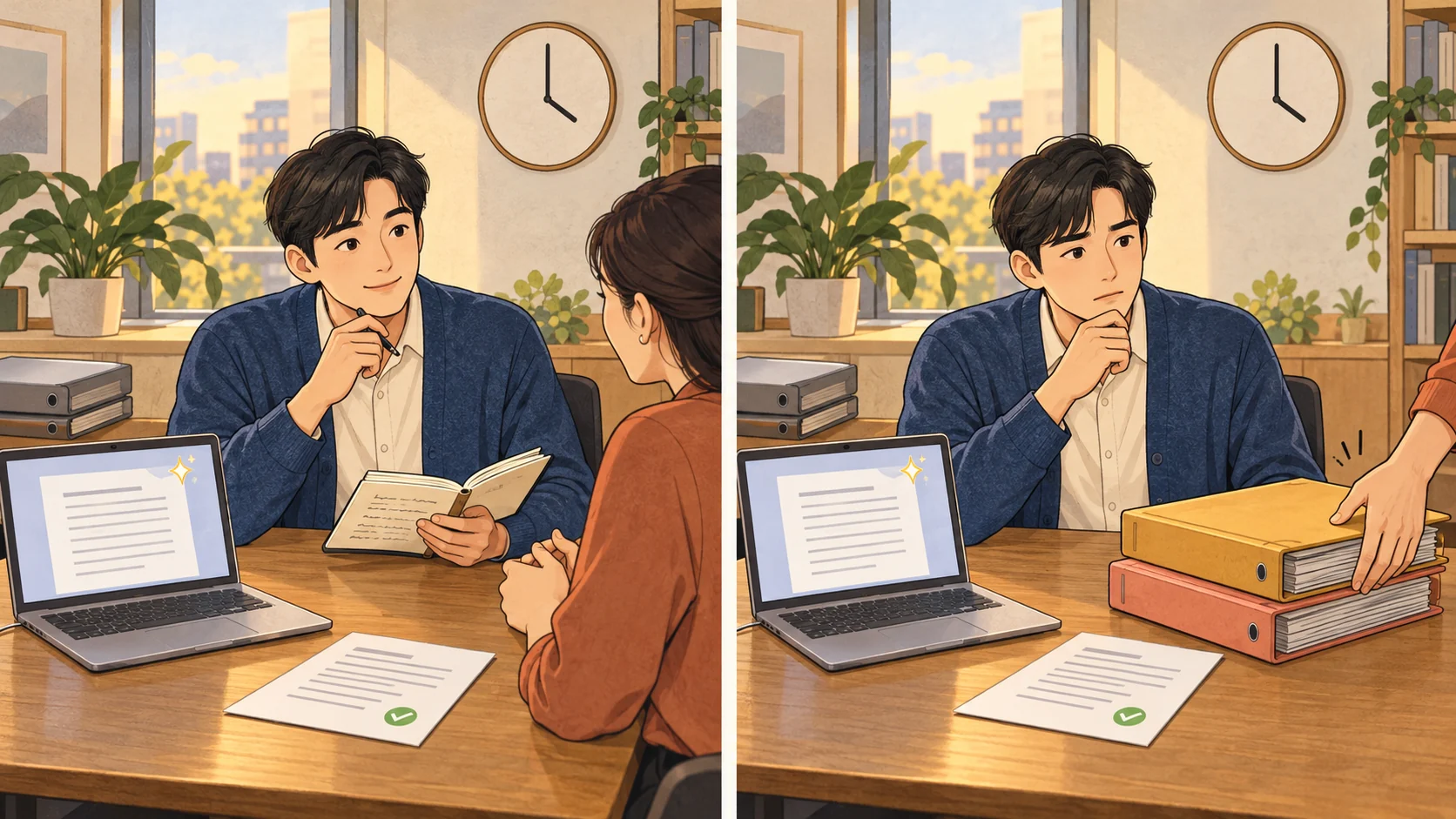
It is four o’clock, with an hour left before going home. This is an explicitly fictional scene. AI helped finish today’s document draft early. What happens in the next hour?
Gallup’s October 6, 2026 US release: 63% of workplace AI users report faster work; 31% say AI led employers to request added responsibilities. [1]
Among faster-work respondents, 37% also reported requests for added responsibilities. [1] Answers overlap: subtracting the percentages cannot count workers gaining free time.
January 26–March 24 fieldwork covered 15,482 employees. Effects: 7,845 who used workplace AI at least a few times during the previous year. [1]
Study leader Molly Blankenship highlighted unequal benefits. [2]
The same desk, a different next task
In the first scene, the employee checks the draft, then talks with a colleague. In the second, two new document drafts arrive at the same time. Finishing the first task early can lead to different schedules. Neither scene reconstructs a survey participant’s experience.
These self-reports establish neither measured productivity nor causation. Added responsibilities alone do not establish overtime or heavier burdens. US findings are not Korean rates.
V’s view
I would like teams introducing AI to discuss who chooses the next task when someone finishes early. Can the employee choose part of their schedule? What comes off their plate when new work arrives? How will changed duties enter their review? Some people may welcome more responsibilities. Asking about choice, and whether earlier duties remain, makes that phrase more concrete.
When today’s document is finished faster, I want to know what the rest of that person’s day looks like. A story about AI’s speed has room for that next scene.