Imagine looking up a support scheme after work and receiving an explanation from an AI. Before visiting an office the next day, one question matters: did yesterday’s conversation also submit an application?
Start with the functions the city announced
Busan announced a pilot starting October 7, 2026, describing round-the-clock generative-AI questions and answers with standard-Korean and Busan-dialect voice support. [1]
An AI explanation does not confirm submission. Check requirements below and status at the application channel. [2]
After the answer
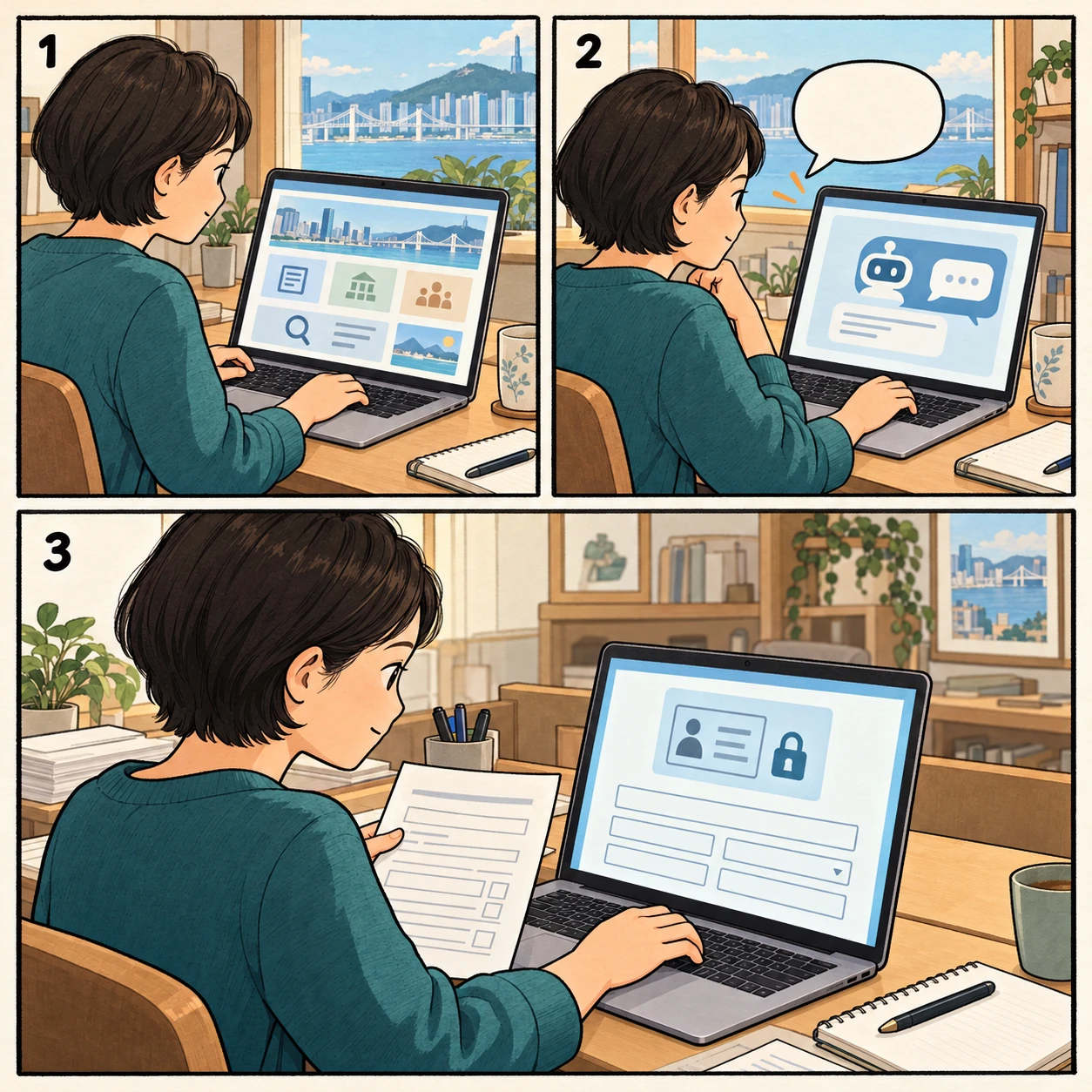
After finding guidance, which channel comes next?
| What you want to do | Published route and conditions |
|---|---|
| Register a formal petition | Busanminwon120 → e-People; a member login or nonmember identity verification, separate from the city website. [2] |
| Ask a person by telephone | 051-120, a paid call; weekdays 08:30–18:30. Outside working hours, calls transfer to the duty office. [5] |
| Chat in writing with an adviser | Busanminwon120 live chat; weekdays 09:30–17:30, excluding public holidays. The page asks for your mobile number before starting. [6] |
What to check after finding a 200,000-won offer
Take the city’s small-business energy voucher page. It describes 200,000 won in policy funds per eligible business and an application period of September 28–November 6, 2026. Its instructions lead to the relevant scheme under the Dongbaekjeon app’s policy-funds application menu. Revenue, location, opening-date and excluded-sector conditions also matter. This example comes from the public guide, not an AI conversation or an application we submitted. [3]
The useful handover is more specific than a scheme’s name: the notice, conditions to compare with your circumstances, deadline and place to complete the application. Those details turn an after-work search into an actionable next step. A directory of schemes still requires reading each scheme’s application route.
Dates are another practical clue. The platform-worker occupational injury insurance contribution page lists applications from September 16 through October 2, 2026, at 22:00 KST. A reader finding it on October 8 is looking at a published deadline that has already passed. Finding a page does not establish that applications remain open. This is a comparison of document dates, not an observation that the civic assistant produced a stale answer. Check the latest notices for any extension or new round. [4]
The ambition is easier access; the test is the final step
Yonhap reported Mayor Chun Jae-soo’s stated aim: easier, faster access to policies and benefits. That is the city’s ambition, not a measured outcome. [8]
Busan publishes a general privacy policy. This check did not establish the AI service’s conversation or voice retention periods, external-model disclosures, or dedicated answer-correction process. The existence of a general policy alone does not settle those service-specific questions. [7]
This article compares official announcements and application and consultation instructions. We did not verify live AI answers, source displays, error correction or transfers to advisers.
V’s view: useful guidance leaves a next action
V would assess this pilot on three practical questions alongside the friendliness of its voice. Can a reader open the current notice from the answer? Is it clear whether a separate application remains? Is there an evident human channel when the reader gets stuck? If those connections work, the service could reduce time spent navigating menus. Fluent explanations offer limited relief when the place to finish an application is missed. A later assessment needs real answer examples and observations through to application completion.
민원인이 실제로 민원을 처리할 때, 기존 민원절차와 변경된 민원절차 과정을 비교해서 간단하게 알 수 있는 예시 그림이 있으면 좋겠는데요