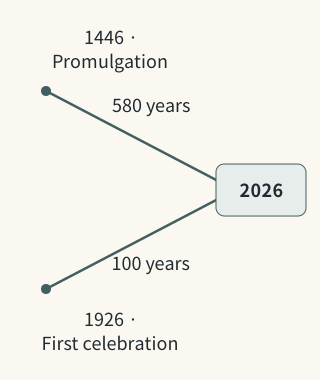
The two numbers in 2026 start from different events. The National Hangeul Museum explains that 2026−1926=100 marks the history of the commemoration, while 2026−1446=580 marks the anniversary of Hunminjeongeum’s promulgation.
The museum’s 2018 account distinguishes two meanings of Hunminjeongeum: the script created in 1443 and the explanatory book published in 1446. Gagyanal was the original name of Hangeul Day. The 1926 celebration took place at Sikdowon restaurant.
The Annals make the precision of a date important. The entry sits under the 29th day of the ninth lunar month in 1446, but its text places the completion of Hunminjeongeum within that month. Its position does not establish an exact promulgation day.
The museum dates the first Gagyanal celebration to November 4, 1926: the Gregorian equivalent of the ninth lunar month’s 29th day in that year.
October 9 uses another document and base year. According to the museum, Jeong Inji’s Haerye preface dates to days 1–10 of the ninth lunar month in 1446. The museum explains that the last day’s solar-calendar equivalent became the commemoration date, without proving the exact promulgation day. These are not two conversions of the same lunar date.
Official accounts differ on the intermediate date changes, so those details remain unsettled here.
Two starting points, one year
A museum exhibition offers a concrete example of bringing these histories into view. In its October 2026 description, the National Hangeul Museum says “Ilguiryuk Muhaniryuk” traces the commemoration’s birth and changes through old newspapers and magazines. Examples include issue 16 of Saebyeol from 1915 and a 1954 KCAC calendar. This is the museum’s account of its curatorial choices, not evidence of visitors’ evaluations.
In the museum’s discussion that month, Hangeul Society president Kim Juwon selected the 1929 founding of the Korean Dictionary Compilation Society as a centenary memory, emphasizing his view that dictionary-making grew from the work of a few scholars into a wider social aspiration.
V’s interpretation: looking back on the centenary can focus not only on when the script appeared, but on how people chose to commemorate it. The history of commemoration also becomes a story of people reading records and choosing dates.
V’s outlook: if the centenary encourages people to explore the newspapers, calendars and dictionaries left behind, Hangeul Day could become a richer occasion for remembering those who carried the script forward, alongside celebrating its beginnings.