Leaves delay trains? Network Rail explains that crushed leaves can leave slippery films, requiring gentler departures and earlier braking. [1]
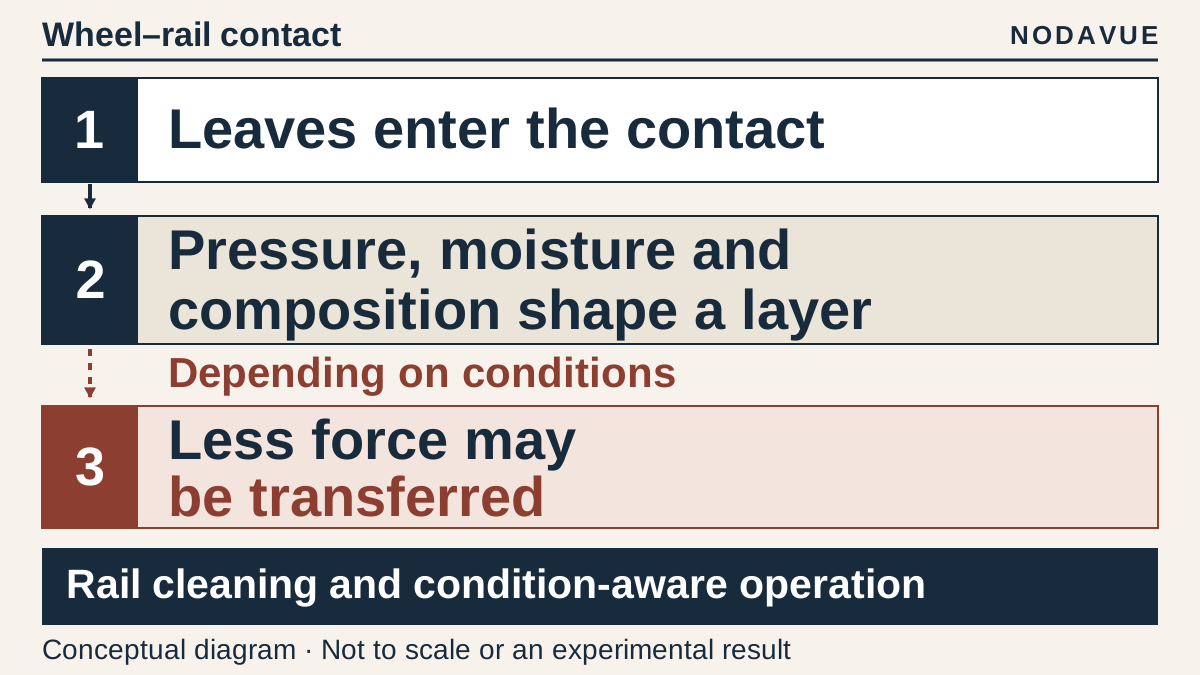
Driving and braking forces pass through the steel wheel–rail contact. Low friction limits the available force; a heavy train still depends on the surfaces. [7]
Contact schematic
Take the leaf apart
In 2020, University of Sheffield researchers examined reactions between a water extract of sycamore leaves and iron. Their results identified the black precipitate as a compound of tannins and dissolved iron ions. Removing tannins increased friction compared with untreated extract. That comparison implicated particular leaf chemicals. [2]
Formation matters too. A 2024 Sheffield–York study indicated that high contact pressure helps transform leaf material into a thin, tenacious layer, with polyphenols, a family including tannins, playing an important role. [3]
Does more rain always mean less grip?
In 2023, investigators on Wales’s narrow-gauge Vale of Rheidol Railway saw blackening begin at damaged leaf areas and wetter layers show lower friction. Heavy rain and trains also removed early layers. The study appeared online in 2024 and in print in 2025. [4]
A Japanese Railway Technical Research Institute study appeared online on 30 December 2025 and in the June 2026 issue. Its public abstract describes rail and wheel specimens, with an iron–tannin film artificially formed on the rail’s friction surface. With distilled water supplied, surfaces with the film transmitted less tangential force than those without it. This did not reproduce every field condition. [5]
What the railway industry sees
In a 2023 explanation, RSSB Research & Development Programme Director Luisa Moisio highlighted electrical contact as well. Leaf layers can raise resistance between wheel and rail, affecting train detection by track circuits. The consequences depend on equipment and conditions. [6]
Network Rail cleans rails with high-pressure water and applies sand-and-steel-grain gel. [1]
RSSB’s 2026 overview highlights variable-rate sanders that supply more sand at higher speeds. [7]
V’s view
Picture a large railway network and tracks and trains come to mind first. Yet its performance also depends on the condition of a small contact beneath each wheel. When conditions change, measuring the material and matching the response to the place and weather are valuable engineering work. To me, this discovery becomes more useful when understanding leaves leads to checking which response works, where and when.
A short limitation
Conditions and leaf species differ. These studies do not establish tannins as every site’s sole cause or predict a particular train’s stopping distance or delay. [2]