Mistral announced Large 4’s API public preview on October 6, 2026. Weights were promised for month-end and remained forthcoming in October 7 records. Who runs the AI you can use today?
Mistral runs the API servers. Preview permits unannounced updates. Launch prices are half-off for two weeks; input, cached input and output have separate rates.
| Category | Sale | Displayed original |
|---|---|---|
| Input | 0.68 | 1.36 |
| Cached input | 0.07 | 0.14 |
| Output | 2.09 | 4.18 |
Reading the price of a document assistant
An API lets software send requests to another service and receive responses. Tokens are text-processing units; they do not correspond to Korean characters at a fixed ratio. Think separately about the text sent in and the answer returned. Caching reuses previously processed material, but a repeated request should not automatically be assumed to qualify for cached-input pricing.
Hypothetical calculation: suppose a document assistant uses one million ordinary input tokens and one million output tokens, excluding caching, additional charges and taxes. Adding the two applicable rates gives $2.77 at the sale prices and $5.54 at the displayed original prices. Neither amount is a real bill or a total operating cost. It also says nothing about how many documents or employees that usage represents. The example shows why a budget needs a time dimension even when comparing identical workloads.
Receiving files and entrusting a server are different choices
Weights are the numerical values a model learns during training. Obtaining them differs from operating a server that receives requests and generates answers. AWS’s general inference architecture guidance describes fully managed services as abstracting infrastructure management and scaling. Self-managed operation increases infrastructure and software control alongside management responsibility. This explains operating models; it does not validate this model’s deployability or costs.
Same request, different operating responsibility
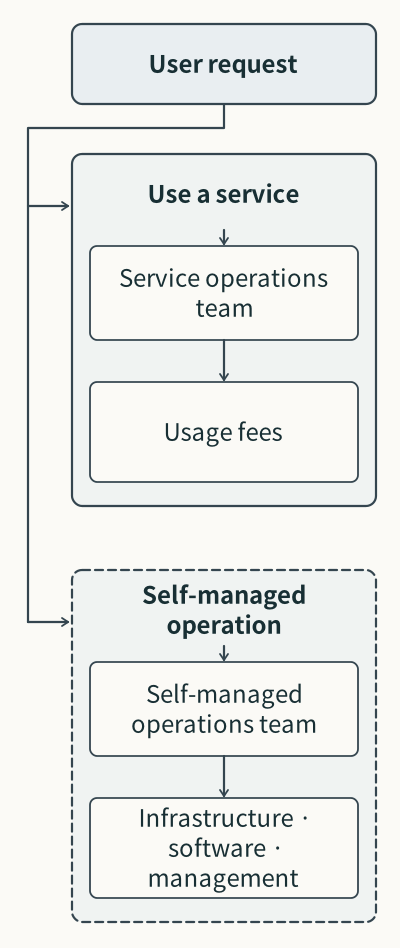
For an organization, the difference extends beyond billing categories. A service customer delegates work through a contract with an external operator; a self-managed customer assigns it to an internal team or a chosen operator. In a hypothetical internal document assistant, the same functionality can lead to different purchasing decisions depending on who handles updates and incidents. This is an illustrative situation, not a reported customer outcome.
Where does separate coverage stop short of validation?
Le Monde noted that third-party confirmation remained outstanding. Separate reporting, including company interviews, differs from independent experimentation. Coverage alone does not establish performance or cost superiority.
V analysis: release changes value when operation can move
What follows is Nodavue’s analysis. A model release’s economic meaning is not determined by the price of its files alone. Room to change services or move operation lets a business compare external contracts with internal operation. That possibility is not a completed migration or a realized saving. Rights, a workable execution environment and operating staff must align before an option becomes a practical alternative.
Weights’ licensing, hardware requirements and total operating cost remain unconfirmed in this reporting.
If files and usage rights become available, and the necessary operating environment is secured, the decision broadens from token prices to where the work should be entrusted. If those conditions are unmet, a release announcement is not itself a usable self-managed option. For a business adopting a document assistant, a useful comparison aligns the cost of processing the same documents and answers over the same period, alongside responsibility for updates, incidents and security. The smallest number on a price sheet matters less than an operating arrangement that can sustain the work.