If molecules resembling left and right hands can smell different, which will a reaction make more of? Announced on October 7, the 2026 Nobel Prize in Chemistry honours Henri B. Kagan and Kenso Soai for nonlinear effects and autocatalysis in asymmetric organic synthesis.
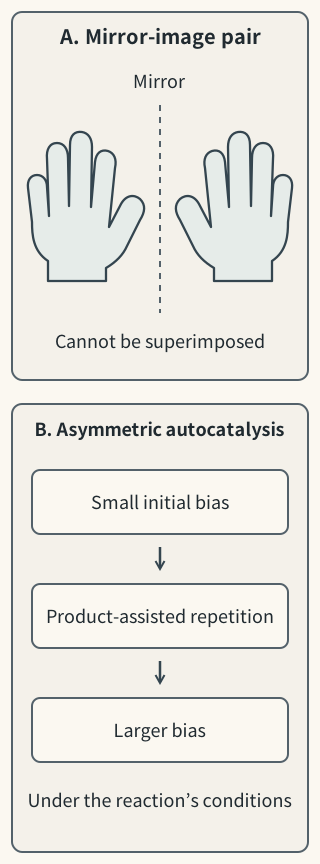
Molecular mirror images resemble hands: reflected partners that cannot be superimposed. ‘Choosing a hand’ means producing more of one form, not molecular intention.
Carvone provides a familiar example. The American Chemical Society’s 2021 background links its R form to spearmint oil and mint aroma, and its S form to caraway and dill seed oils. Spatial arrangement can matter to sensory experience. This was not a new Nobel-winning smell experiment, and not every mirror-image pair smells different.
Two ways to understand a growing difference
The Royal Swedish Academy describes Kagan’s 1986 nonlinear effect as a larger-than-expected predominance of one mirror image. Starting bias and resulting bias need not follow a simple proportional relationship.
In the Soai group’s asymmetric autocatalysis, the product helps make more of itself. Reusing it in subsequent reactions can amplify a small initial bias. This was separate research, not a shared reaction with Kagan or a rule for every mixture.
Keep two questions apart: ‘How proportional are the starting conditions and the outcome?’ and ‘Does the outcome help drive subsequent production?’ The first clarifies nonlinearity; the second clarifies feedback. Losing that distinction makes separate discoveries look like one universal amplification method.
Two concepts compared
An award is not a complete history
Nobel chemistry committee chair Heiner Linke praised the work on how chemical asymmetry can arise spontaneously: an award-body assessment. Separately, El País journalist Daniel Mediavilla distinguished laboratory research from what actually happened on early Earth.
Laboratory amplification does not establish the whole history of life’s origins. The award date also differs from the dates of earlier discoveries. These mechanisms alone establish neither a particular drug’s effectiveness nor immediate industrial benefits.
V’s view: ask when the difference grows
The value of this story lies less in declaring that one side won than in asking how the difference grew. If the explanation proves reproducible across broader conditions, the next question will be where feedback persists and where it stops. That is an outlook to test, not an established result. Explaining life’s past requires additional evidence between a possible pathway and the pathway that actually occurred.