On October 5, OpenAI announced plans to introduce watermarks to ChatGPT·Codex text in the EU. For a teacher reading an assignment or a colleague receiving a report, the questions are what the person understood, which decisions they made and whether the result can be trusted.
First, where does it apply?
| Scope | Status |
|---|---|
| EU ChatGPT·Codex | Rollout announced; completion/eligibility unconfirmed. |
| Non-EU consumer products | Global default unannounced; absence not guaranteed. |
| Worldwide API | Opt-in, off by default; model list unconfirmed. |
| Text detector | Access restricted to approved research/academic institutions. |
textGrain uses statistical word choices, not hidden characters/spaces.
False positives are possible; brevity/editing/translation limit detection. Neither outcome proves authorship, contribution or accuracy.
Company tests cover 24 EU official languages; Korean performance is unconfirmed here.
Marking duties and public disclosure have different scopes
EU Article 50(2) concerns providers’ machine-readable marking; paragraph (4) concerns disclosure for certain public content. Each has conditions and exceptions. The Commission gives August 2, 2026 as the application date for the transparency obligations. Legal duties and the voluntary code are distinct; a product announcement is not an individual compliance determination.
Commentary V: ask about decisions behind the work
Imagine a hypothetical workplace scene. Two people submit similarly polished proposals. One compares customer requirements, rejects unsuitable suggestions and explains the evidence behind the remaining choices. The other submits the prose but cannot explain those choices. The useful distinction here is the ability to explain decisions, rather than polish alone. This is neither a reported case nor a measurement of either person’s contribution.
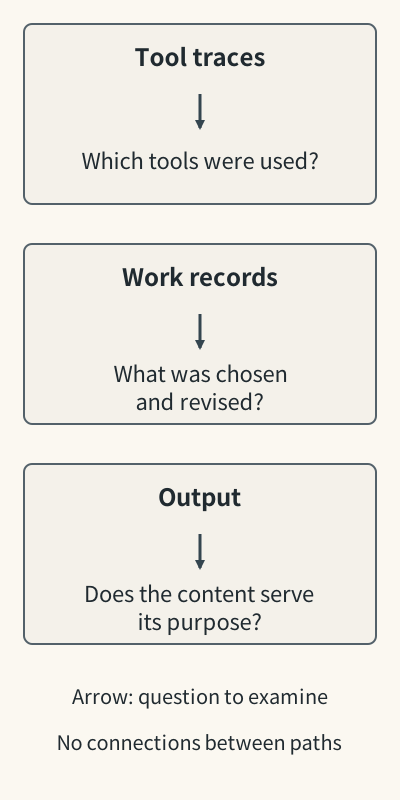
Evaluating work requires evidence suited to the question. To understand choices and revisions, changes between drafts or reasons for rejecting alternatives can help. To explore understanding, ask the person to explain the work in their own words. To decide whether to use the result, examine its evidence, fit with requirements and wording in context. Records and explanations are imperfect, but they can reveal what to ask next. Examining tool traces, understanding human work and evaluating an output are distinct judgment tasks.
Concept diagram: different evidence, different questions
We did not directly test detector performance; applicability to Korean text and account-level availability remain unverified.
텍스트만으로 AI 생성여부를 판단하는게 가능한 방식인가요? 결국 출력문의 일부 단어를 치환하거나 해당 규제가 없는 로컬 LLM을 통해 재생성하는 우회 등이 얼마든지 가능할 것 같은데요.