On October 6, OpenAI released its internal AI’s mathematical manuscripts and some formalization materials.
The question you can see by counting to 100
A prime is an integer greater than 1 divisible only by 1 and itself. The numbers 2, 3, 5 and 7 are examples. We can count them individually in a small range, but for much larger ranges we want a way to estimate how many there are. That leaves two questions: what is the expected count, and how far can the actual count depart from it?
The comparison below places the count of primes up to 100 beside a smooth numerical estimate. This estimate uses a logarithmic integral, accumulating the reciprocal of the natural logarithm from 2 to 100.
| What is compared | Value | How to read it |
|---|---|---|
| Actual prime count | 25 | Counted through 100 |
| Estimated prime count (logarithmic integral, starting at 2) | About 29.1 | An estimate from continuous calculation |
| Absolute difference | About 4.1 | Here the estimate exceeds the actual count |
A fractional estimate does not mean that primes exist in pieces. The actual count is an integer, while a continuous calculation estimating that count need not be. This small example shows what an error means. A theorem limiting how far estimates can miss in larger ranges answers an additional question beyond supplying an estimate.
Clay explains that RH would control prime-count errors on a square-root-times-log scale. Hidden constants and sufficiently large ranges are involved, so this is not an exact numerical allowance.
Why is the Riemann hypothesis linked to the irregularity of primes?
A function is a rule that takes an input and returns a value. A zero of a function is an input where that value is 0. Complex inputs can be drawn with horizontal and vertical coordinates, allowing us to discuss zero locations on a plane.
RH says all nontrivial zeros of the prime-linked zeta function have horizontal coordinate 1/2. Points with horizontal value 0.5 form a vertical line; their vertical values can differ. This means neither half the primes nor 50% progress.
Quasi-Riemann also asks about zero locations, but claims an empty region at the right edge. The September 30 main manuscript uses 7/8; the October 5 alternative uses 11/12. The later claim is weaker. The main manuscript claims a fixed boundary at all heights. This is an author claim, not this reporting’s verification.
To see the difference, suppose a nontrivial zero had horizontal coordinate 0.7. This is not a discovered zero. That hypothetical point would contradict RH because it is off the 1/2 line, but it lies left of 7/8 and would not be excluded by a claim that only the region to its right is empty. Clearing the right edge and placing everything on the middle line are different propositions.
Three boundaries, one scale
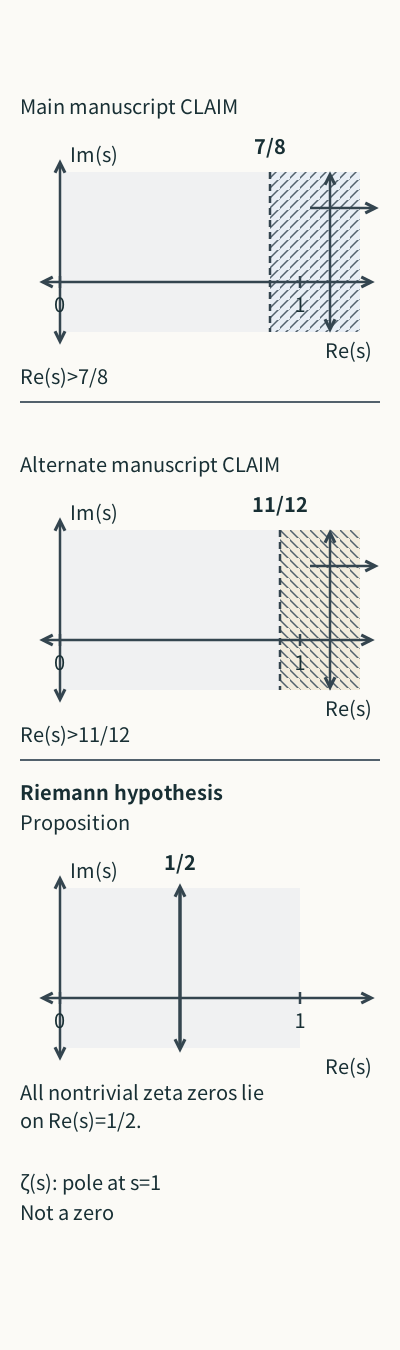
Public manuscripts and formalization links allow outside comparison. Manuscript links and result families below are different units, not solved-problem counts.
What the numbers count
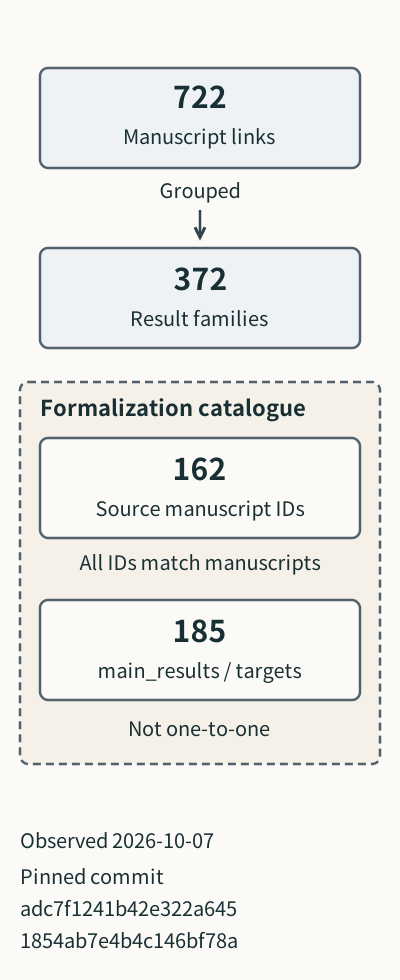
The formalization catalogue’s unchecked is a review status, not a false-proof verdict. Lean’s guidance distinguishes an accepted formal proof from correspondence with the intended mathematical statement, requiring attention to definitions, axioms and dependencies. This reporting inspected the catalogue statically; it did not execute Lean or validate complete manuscript proofs. That does not assert that no verification exists elsewhere.
Layers of verification questions
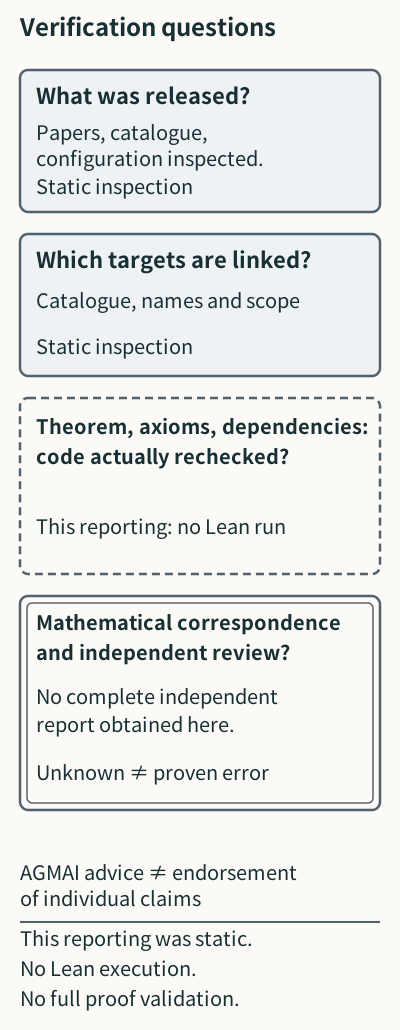
Mathematical advice and an AI company’s expectations
The independent advisory group AGMAI calls the release important for the mathematical community. It says human understanding and integration into knowledge are only beginning and community assessment is needed. Advisory participation does not guarantee the results. It is not IAS certification or validation of every manuscript. Its general guidance also asks for clear proofs, preserved versions and tool access; that is distinct from a review report on these results.
OpenAI, the announcing supplier, says it will support workshops, conferences and special programs for understanding the results and is preparing to release the producing model. These are plans, not confirmation that programs occurred or current ChatGPT reproduces the results.
V’s analysis and outlook
V will judge the next achievement by the quality of connections rather than the size of the number. If core arguments withstand outside examination and become tools for other research, this release will become a starting point beyond a long catalogue. Results whose central ideas people can explain again and extend to further applications would be the next news showing that transition.