Must you put a phone down to sign a message? Google’s SL2T supports one-handed American Sign Language (ASL) input. RIT’s Gary Behm describes replacing typing with signing into a camera.
The occupied hand becomes a design condition
The joint report describes masking the non-dominant arm’s landmarks during training to simulate one-handed signing.
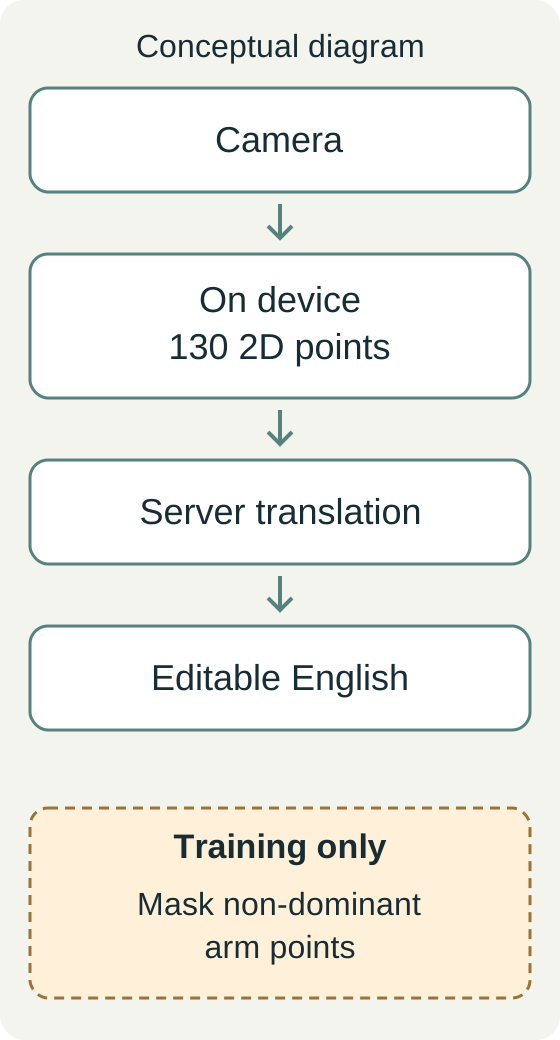
V’s reading: an occupied hand becomes an expected input condition. The training choice follows how someone holds the device. The reviewed sources do not isolate masking’s contribution.
Translating meaning
ASL has its own grammar. In Google’s published example, a signed description of the Cook Islands becomes English that preserves the count of 15 islands and the names Rarotonga and Aitutaki while rewording the sentence. This is the developer’s example, not a test we reproduced.
What you can use today
Google specifies Pixel 11, current Gboard and an en-US or en-CA keyboard. Camera permission is required. The English output remains editable in the text field. Support covers ASL→English, not Korean Sign Language or all phones.
The benefit may shrink for someone unable to check the English draft.
Another place to start
This adds an everyday communication option; it does not replace qualified interpreters for consequential medical or legal conversations.
V’s conclusion: another input route starts in ASL and ends with checking English.
Our conveyor-keyboard article also rethinks the relationship between a hand and an input device. Read it for another design idea, rather than a performance comparison.
Sources and scope
These are project sources. We did not independently test the product.