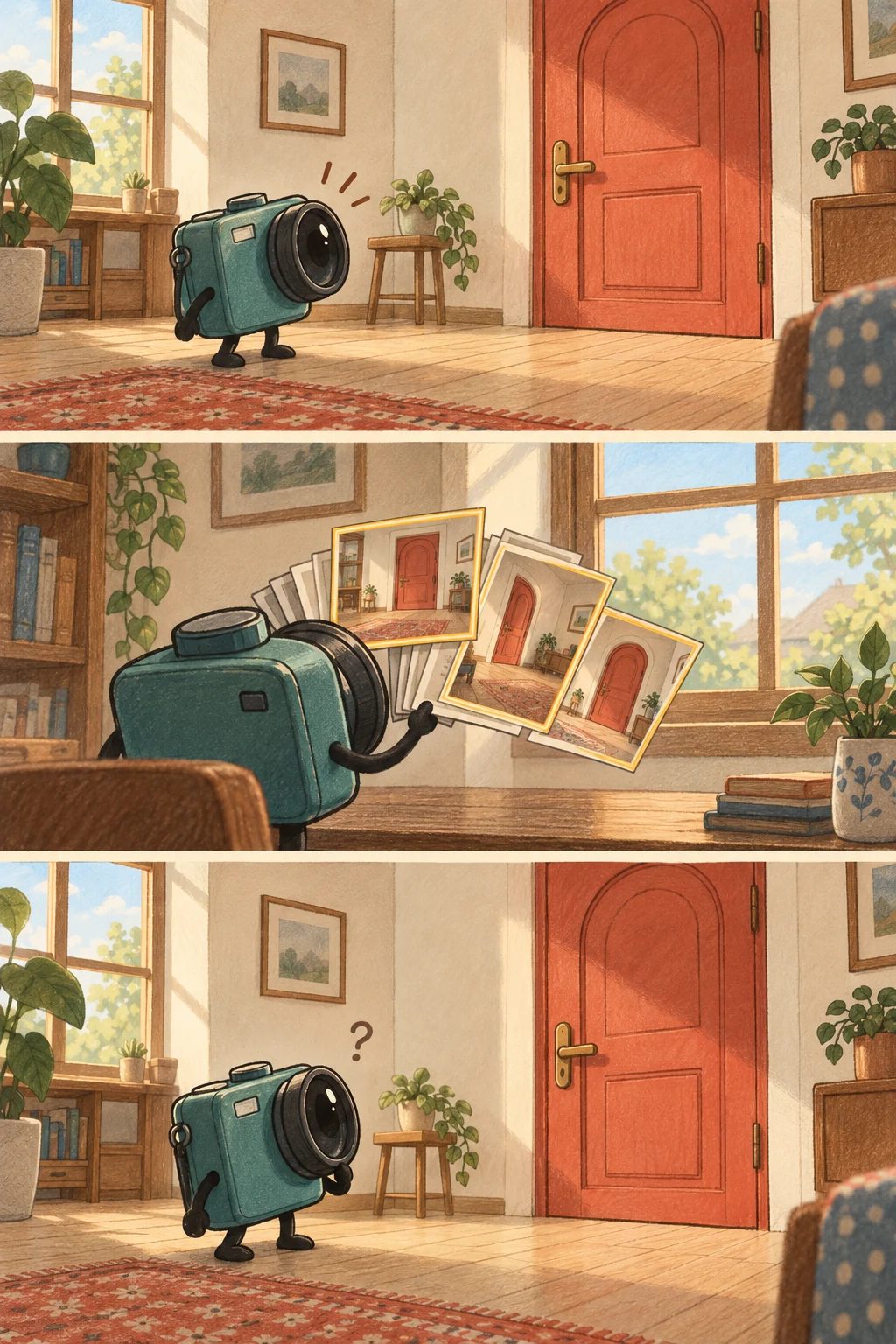
Imagine a red door in an unfamiliar room. Turn left, then look back. Will the same door be waiting? If AI keeps drawing the next view, a familiar room might change on your return. This is an imagined scene, and a useful question to bring to generated worlds.
WorldCrafter’s September 21 preprint shows a classroom instead: the camera looks around and returns at 37.1 seconds to the chalkboard’s lettering and globe drawing. This is the authors’ example, not a door test. [1]
In the inspected commit’s default memory setting, the latest view and eight historical views are chosen to cover the upcoming view. Their compressed video information and camera poses feed a memory processor. [2]
Picture an artist opening earlier sketches before drawing the view behind them. Sketches supply clues to appearance. A ledger of object coordinates would play a different role. This is an analogy for the information being reused. [2]
The project pairs generated videos with point clouds reconstructed from them afterward. Those visualizations help inspect spatial agreement between views. My reading: recognizing a room again leaves separate questions about collisions and physical laws. [3]
Across 145 scenes and five paths each, the authors report revisit LPIPS of 0.255 for WorldCrafter versus 0.487 for Lyra 2.0. Lower means more similar views. [1]
The paper also says complex or extended paths can still break consistency. The examples and measurements here come from the authors. [1]
V’s view. If returning becomes more dependable, choosing a route and finding your way back could become part of the pleasure of exploring an AI landscape. In a game, a landmark that changes each time you return makes learning the route pointless. I’m curious how much a familiar return could add to the pleasure of exploration.